Be Trusted: Why Brand Trust Now Depends on a Strong Brand System
Brand trust is no longer a story—it is an organisational capability

Laurens Hoekstra
Co-CEO
For years, many organisations treated trust as the outcome of a strong brand story. Define a compelling purpose, sharpen the positioning, articulate the values, and trust would follow.
That logic is no longer enough.
Today, brands are not only experienced by customers, employees and partners. They are also read, summarised, restructured and increasingly generated by AI systems. Content engines rewrite copy. Assistants summarise value propositions. Algorithms determine visibility.
Machines do not understand intention. They work on structure.
In the age of AI, trust is no longer built by a brand story alone. It is built on how well your brand is organised, implemented and governed.

Trust now lives at the intersection of people and machines
One of the sharpest realities in brand management today is this: brands must now work for both humans and machines.
For people, you design emotion, surprise and meaning.
For machines, you design clarity, structure and consistency.
Brands must now work for both humans and machines. Good brand management sits exactly at that intersection. That is not an abstract observation. It has practical consequences for the boardroom.
“What is not explicit, organised and governed becomes vulnerable.”
If brand knowledge lives only in the minds of a few experienced colleagues, AI cannot work with it reliably. If tone of voice is inspirational but not operationalised, it cannot be applied consistently at scale. If brand assets are fragmented across folders, agencies and markets, the brand becomes harder to manage, harder to protect and easier to dilute.
From brand strategy to brand system
In 2026, trust still begins with brand. McKinsey’s State of Marketing Europe 2026 shows that branding ranks as the number one priority for European marketing leaders. At the same time, branding remains one of the biggest action gaps. Leaders know it matters, but many organisations still lack the maturity to execute it consistently.
“Leaders know it matters, but many do not yet execute it consistently.”
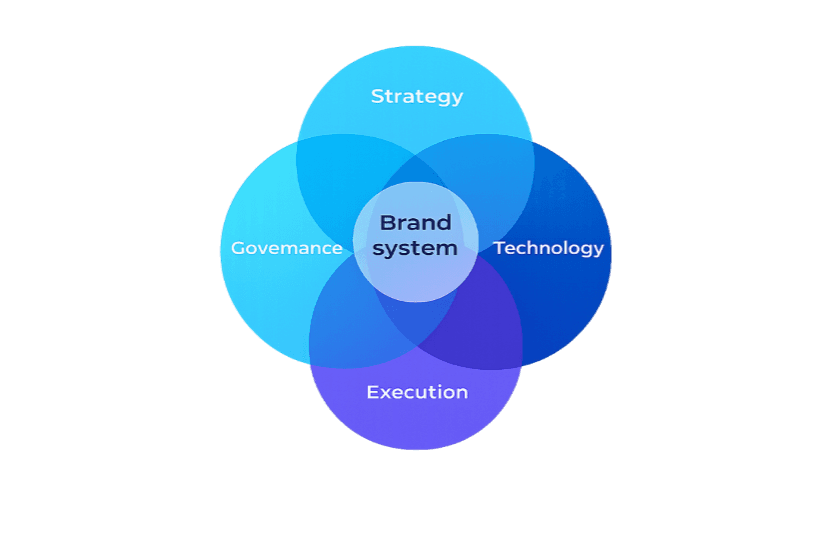
Trust is not delivered by strategy alone. It is delivered by the system around it.
A strong brand system consists of:
Brand strategy
Governance and decision rights
Processes and workflows
Tools, assets and data
Why this matters at C-level
For CEOs and boards, the conversation about trust needs to become more operational.
Trust is no longer only a communications issue. It is also:
a governance issue
a data and compliance issue
a tooling issue
an implementation issue
McKinsey’s research points to a market in which turbulence, digital acceleration and AI are pushing leaders back toward fundamentals: brand, consistency and emotional connection as anchors in volatile conditions. At the same time, branding is becoming more interactive, more dynamic, and more distributed.
“Trust is no longer only a communications issue.”
Those shifts are only sustainable when the underlying brand system is strong enough to support them.
The executive question therefore changes from:
“Do we have a compelling brand?”
to
“Do we have an organisation capable of delivering that brand consistently, across markets, channels and machine-mediated environments?”
Where trust breaks down
A multinational organisation may have a strong strategic story and a widely admired visual identity.
But if every market uses its own templates, agencies interpret the brand differently, and teams cannot easily find approved assets, the real brand experience becomes inconsistent.
“Inconsistency is not only inefficient. It undermines trust.”
Customers experience fragmentation. Employees lose confidence in what “good” looks like. AI systems trained on inconsistent inputs reinforce ambiguity instead of coherence. That inconsistency is not only inefficient. It undermines trust.
What boards should do now
Boards should treat trust-building as a capability question, not just a creative question.
That starts with five practical questions:
Do we have clear ownership of the brand across the organisation?
Are our guidelines usable, current and operational?
Can teams access approved assets easily and globally?
Are local freedoms and central guardrails clearly defined?
Is our brand structured well enough to remain coherent when AI enters the workflow?
Closing the gap between brand strategy and execution
That gap is where VIM Group operates.
At VIM Group, we believe a trusted brand is not just well defined. It is well organised. It is supported by a brand operating system: clear governance, usable guidelines, structured assets, smart tooling and disciplined implementation.
Because in an environment shaped by both people and machines, a brand only remains trustworthy if it remains coherent.
A brand only remains trustworthy if it remains coherent.
Would you like to exchange thoughts on this topic?
Feel free to reach out to me at laurens.hoekstra@vim-group.com or +31 6 52 58 26 02.