Tips for simplifying your brand architecture and organisation
What does it actually mean?

Marc Cloosterman
Senior Advisor Team Farner
In the world of brands a clear trend is emerging: where large organisations used to have extensive brand portfolios with a parent brand and various sub-brands, we increasingly see brand architectures being brought together and simplified. Bringing more unity to your brand architecture is therefore the way to create more efficiency in the day-to-day management of your brand. Operating costs come down, internal processes are streamlined and brand performance is maximised. Benefits that are all high on the agenda of brand managers worldwide. Besides the operational advantages, more unity can also considerably increase the effectiveness of your brand architecture. It allows your brand to grow and makes it stronger. Essential in a world where competition is increasing ever faster.

What does simplifying your brand architecture mean?
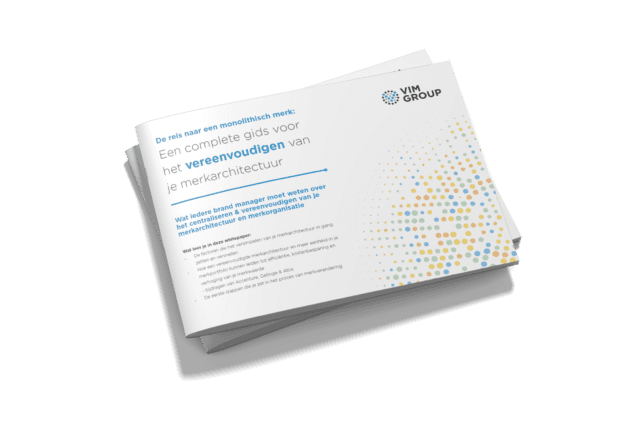
In the whitepaper ‘A complete guide to simplifying your brand architecture’ we look at the way brands are increasingly being simplified, from the perspective of brand architecture and brand organisation. Simplifying your brand architecture does not by definition mean eliminating brands from the brand portfolio. It can also be about improving the visual coherence between the various brands, so that target groups and stakeholders experience more consistency. Rationalising and simplifying your brand organisation means bringing the procedures, systems and tools for managing the brand closer together so that they work better as a whole. Simplifying your brand architecture and organisation can deliver considerable advantages through scale, lead to greater efficiency in processes and thereby ultimately help organisations improve their brand performance and their competitive position.
“It is not the strongest or the smartest who survives, but the one who is best able to deal with change”
Why choose a simplified brand architecture?
Often attributed to Charles Darwin, the quote above actually belongs to Leon C. Megginson, professor of Management & Marketing at the University of Louisiana in 1963. Misattributed or not, the quote is highly relevant when we look at the changes taking place in the world of brands today. There has always been a need for brands to adapt to change. But business is changing so fast that continuous transformation has become a strategic necessity. Brands that are more flexible win; brands that are not, fail. A great deal has been written and published about strategic and organisational agility. McKinsey & Company have even demonstrated that the agility of an organisation or a brand determines how great its capacity is to compete (at scale) in turbulent markets. That flexibility does, however, have to be built on a foundation of stability.
The world is changing fast. The World Economic Forum even describes the current era as the ‘Fourth Industrial Revolution’: a time with many business challenges. Because of various technological and social developments, the context in which brand managers operate is unpredictable and competitive. The emphasis is shifting more and more towards short-term experiments instead of long-term plans. Flexibility – or the ability to manage change – has therefore become increasingly important for brand managers. Where intangible assets used to make up 20% of the company balance sheet, in recent years this has grown to as much as 80%. This means that leadership, intellectual capital, the brand and other intangibles increasingly determine the value of an organisation.
Managing your brand more efficiently, saving costs and improving brand performance
So the brand plays an ever more important role. That also means you have to manage the brand in a way that strengthens your competitive position – but how do you do that? The key to success lies in simplifying your brand architecture and centralising the internal organisation of the brand. By simplifying your brand landscape and organisation, you can reach new levels of collaboration as an organisation, manage your brand more efficiently, save costs, build more brand equity and ultimately improve your brand performance.
But what exactly does simplifying your brand architecture and organisation mean for a brand? What benefits does it bring, and how do you get the process started? In the whitepaper we share insights into the biggest trends in the world of brands. We look at both the opportunities and the risks you need to take into account as a brand manager. We share the experiences of organisations that have already been through the process of ‘simplifying’ with their brand and unravel how this can work for your business results and your position in the market. Finally, we show how best to set a brand change in the area of architecture and organisation in motion.