Current trends and developments in branding
A report from our exclusive pre-event on the theme ‘How to Future-Proof Your Brand?’

VIM Group
On Thursday 29 March 2018, the most important marketing awards in the Netherlands were presented once again at the KIT in Amsterdam: the Dutch Marketing Awards. The highlight was the announcement of the Marketing Company of the Year, this year claimed by one of the finest brands in the field of beauty & wellness: Rituals.

Het Tropenmuseum te Amsterdam, tegenwoordig het Wereldmuseum
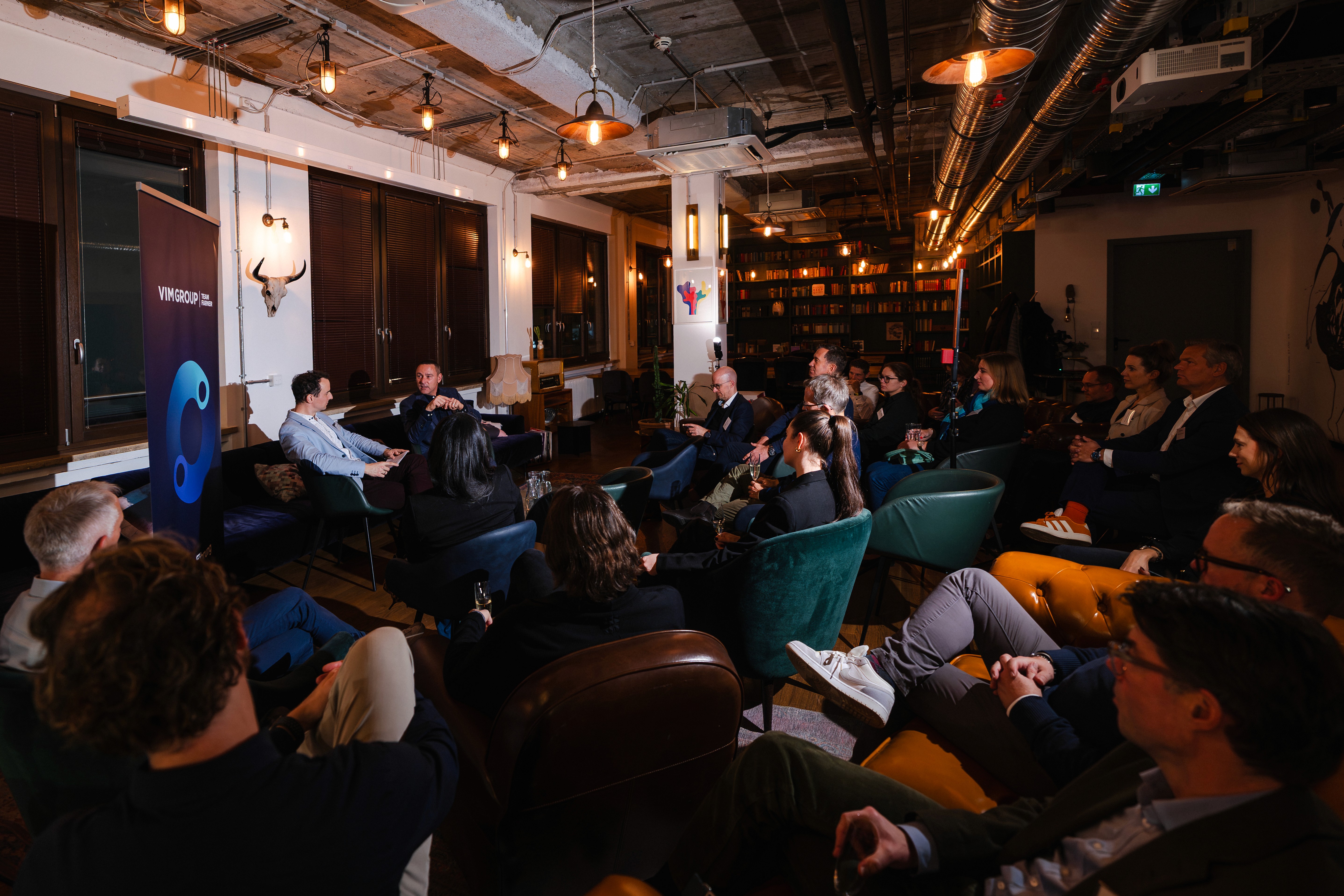
Ahead of the awards ceremony, VIM Group hosted an exclusive pre-event in the council chamber of the KIT on the theme ‘How to Future-Proof Your Brand?’. Yolanda van Die (Global Brand, Marketing & Communications Leader at EY), Nanne Bos (Head of Global Brand Management at ING) and Laurens Hoekstra (Managing Partner VIM Group and author of the book ‘Future-Proof Your Brand’) joined a select group of brand leaders to discuss the impact of various trends & developments on the branding profession and exchanged tips on how to handle brand management in a changing digital culture.
The brand belongs in the boardroom
Laurens Hoekstra kicks off the session with the proposition: “The brand belongs in the boardroom”. He is surprised that there are still so many organisations that do not properly appreciate the value of the brand: “On average, 18% of an organisation’s value can be attributed to the brand, and yet we see that the brand is often still not an important item on the boardroom agenda”. To illustrate the value of brands, Hoekstra presents a black cap: “When the ‘Balenciaga’ brand is added to a simple black cap, we are willing to pay as much as 225 euros. And this applies not only to products – people and organisations also represent brands of value. Think of Neymar, the footballer who was sold for 222 million. Or the ING brand, which represents a value of no less than 7.7 billion.”
Laurens Hoekstra: “When the ‘Balenciaga’ brand appears on a cap, we are willing to pay as much as 225 euros.”
From the audience comes the question of how exactly you can make this value tangible. “That is a good question”, Laurens answers. “You can calculate brand value using the ‘royalty relief’ method. Financial data and marketing data form the basis for this. At VIM Group we work together with Brand Finance. They use an ISO-certified method for making the value of your brand visible.”
What is valuable has to be managed
“The brand is hugely valuable and yet we see that it is still one of the least organised disciplines in organisations. And that is putting it mildly – in many organisations the brand is a complete mess”, says Laurens. He explains that this has to do with a number of factors: “First of all, we see that the brand is organised in silos. Think of marketing, communications, facilities, IT and HR. There is often far too little collaboration between these disciplines. On top of that, in many organisations branding attention goes mainly to strategy and design. Actually implementing and organising the brand well across all brand carriers is often forgotten.”
Yolanda van Die adds: “At EY you also see the focus shifting more and more towards data-driven marketing. Inbound marketing, marketing automation, online lead generation. Those are the themes that take centre stage. Is this at the expense of attention for the brand?” Laurens: “You see that happening a lot in organisations. Organisations do not realise that these kinds of marketing initiatives can only work if you also make sure, in the long term, that you build a rock-solid brand.”
Laurens Hoekstra: “In many organisations the brand is a complete mess.”
Yolanda: But how do you do that? Manage your brand well and make sure your brand is ready for the future? Laurens: “So much is changing right now. The arrival of 5G (unlimited bandwidth), the fact that we are connected anywhere and at any time, virtual reality. All these developments mean that the ways in which your customer comes into contact with your brand are changing and continue to expand. If you want a future-proof brand, you have to respond quickly to all these changes. My advice: organise the processes in your organisation in an agile way. On top of that, data is playing an increasingly important role. You have to make your brand performance measurable, because the boardroom expects hard data. A good Brand Dashboard is an excellent tool for that. It is also important to keep learning. Experiment with what works and what does not work, and keep developing the brand.”

Laurens ends with his most important piece of advice: “Take the brand as the starting point for everything you do and make it part of the organisational strategy. Our Brand Performance Study, research we carried out together with the University of Twente, shows that only 27% of the brands we studied use the brand as the starting point for everything they do. The same research also shows that the organisations that do see the brand as a strategic starting point deliver better (brand) performance.”
From the audience comes the question of what profile the brand manager of the future should have. Laurens answers: “The most important thing is that, as a brand manager, you develop business management knowledge. In most marketing and communications programmes this piece of knowledge is missing.”
9 predictions about the future of branding
Nanne Bos has worked for ING for 11 years. At the end of the crisis, just before Ralph Hamers took office, he became responsible for the brand. Nanne: “That was a major challenge right from the start. Trust in banks was very low and it is still being severely tested. The financial sector is under a magnifying glass. On top of that, ING is growing extremely fast, both within and beyond national borders. That is why the brand is now more important than ever. It was the moment to take a new direction and bring our ‘purpose’ to the heart of our strategy.”
Nanne Bos: “The financial sector is under a magnifying glass. That is why the brand is now more important than ever.”

What is the future of the brand? Which developments are taking place and how can we prepare for them? Nanne outlines 9 predictions about the future of branding:
1. From product brand to purposeful brand
Nanne: “The brand is becoming more and more important. An organisation is increasingly the brand. Technological developments are creating enormous transparency. As a result, we see less and less separation between the organisation and the product.” “Is ‘purpose marketing’ becoming increasingly important in that respect as well?”, Yolanda asks. Nanne: “Absolutely, a strong reputation is driven by an authentic ‘brand purpose’ and that will only increase in the future. Organisations are increasingly expected to have a higher goal and to add value to society. Relevance is becoming more important than ever. You have to convey that through your brand.”
Nanne Bos: “A good reputation is strongly influenced by ‘brand purpose’ and that will only increase in the future.”
2. The boundaries between roles are blurring
“These times call for a different way of organising. Organisations have to become faster and more agile. As a result, the traditional boundaries between departments are blurring. The agile way of working accelerates that process”, Nanne states. “In the near future the marketing function as it was will make way for new forms, and there will no longer be a marketing department operating separately from the rest of the organisation. The work of marketing will not disappear, but we will organise it differently. Marketing professionals will remain specialists, but they will broaden their knowledge and work far more closely with IT and other disciplines within the organisation.”
3. The customer becomes a ‘user’
Nanne explains: “In the past, brand management was about achieving a relevant position in the mind; in the future it will be about finding a relevant position in the daily routine. Usage feeds loyalty and increases the chance that you can continue to play a relevant role. That is why we should no longer think about the brand in terms of products, but in terms of the interaction with the user. And that is a switch many organisations still have to make.”
Nanne Bos: “In the future, brand management will be about finding a relevant position in the daily routine.”
4. From enforcing consistency to encouraging coherence
But how do you organise a good handover of your brand design in a digital context in which there is more and more interaction with your brand? Nanne’s advice: “These days you can no longer see UX separately from the brand. That needs attention. It is also important to let go of the principle of a brand police force exercising strict control. That is at odds with the flexibility and innovation we want to bring into the company. The brand belongs to everyone. You do not want to slow that process down. So shift your focus from enforcing consistency to encouraging coherence.”
5. The future lies in voice marketing
“Right now the focus is mainly on developing interfaces and applications for mobile, but this is going to change quickly”, Nanne predicts. “I expect that we will ultimately move towards voice-controlled interfaces. Look at technologies such as Google Home and Amazon’s Alexa.” From a brand management perspective, this development leads to interesting questions. So the audience asks how the voice of ING is going to sound. Nanne laughs and answers: “We are going to have to think about that. It is important to create a personal connection with customers. But how do you do that, and how do you convey the brand’s message when something or someone else speaks on behalf of your brand? The questions in the field of brand management are changing. As an organisation you have to be prepared for that.”
6. Two groups are emerging: customers who choose convenience and customers who consider privacy more important
“In digital culture, privacy is increasingly becoming a point of discussion”, Nanne states. “Within your target group you see an ever stronger split emerging between 1) customers who value convenience and therefore accept that their personal data is collected and used and 2) customers who put their privacy first. As an organisation you have to have a clear position on this and incorporate it into your strategy. Can you serve both groups or do you make a choice? Privacy issues are becoming increasingly important.”
7. Brands are being stretched ever further
Nanne: “Brands such as Amazon have stretched themselves ever further into different domains and are successful at it. Yet we also know that ‘stretching’ brands brings risks with it. The branding laws of the past are up for debate. To remain relevant as a brand you have to keep exploring possibilities. Experiment with new brands and partnerships, because in the future it will become increasingly important to serve a broader market.”
Nanne Bos: “With the overload of information that comes at us every day, it is increasingly difficult for a brand to get the attention of its target group.”
8. Reaching customers is becoming increasingly difficult
“With the overload of information that comes at us every day, it is increasingly difficult for a brand to get the attention of its target group”, Nanne states. Big ideas therefore remain very important – and are taking on increasingly extreme forms. Think of the attention Tesla received by launching a car into space. Not so long ago that kind of activity was unthinkable. From a brand management perspective it is important to think about this: how can your brand distinguish itself from the rest and how do you hold on to attention?”
9. From brand governance to brand collaboration
Who owns the brand? What are the relationships within the organisation? Those are questions that will become less relevant in the future. Nanne’s advice: “Let go of the fixed structures. Do not think in terms of separate roles and different specialisms within the marketing department. Think more broadly. The brand should be the result of collaboration within the organisation. Together we are responsible for conveying the brand and for its success.”

The session is closed with a number of questions from the audience, after which we enjoy a delicious dinner together and the presentation of the Dutch Marketing Awards.