Markengeflüster July 2025: Transformation up close with DB Schenker
A summer evening of brand insights and personal exchange with DB Schenker & Co
Emma Breukel
Brand Change Consultant
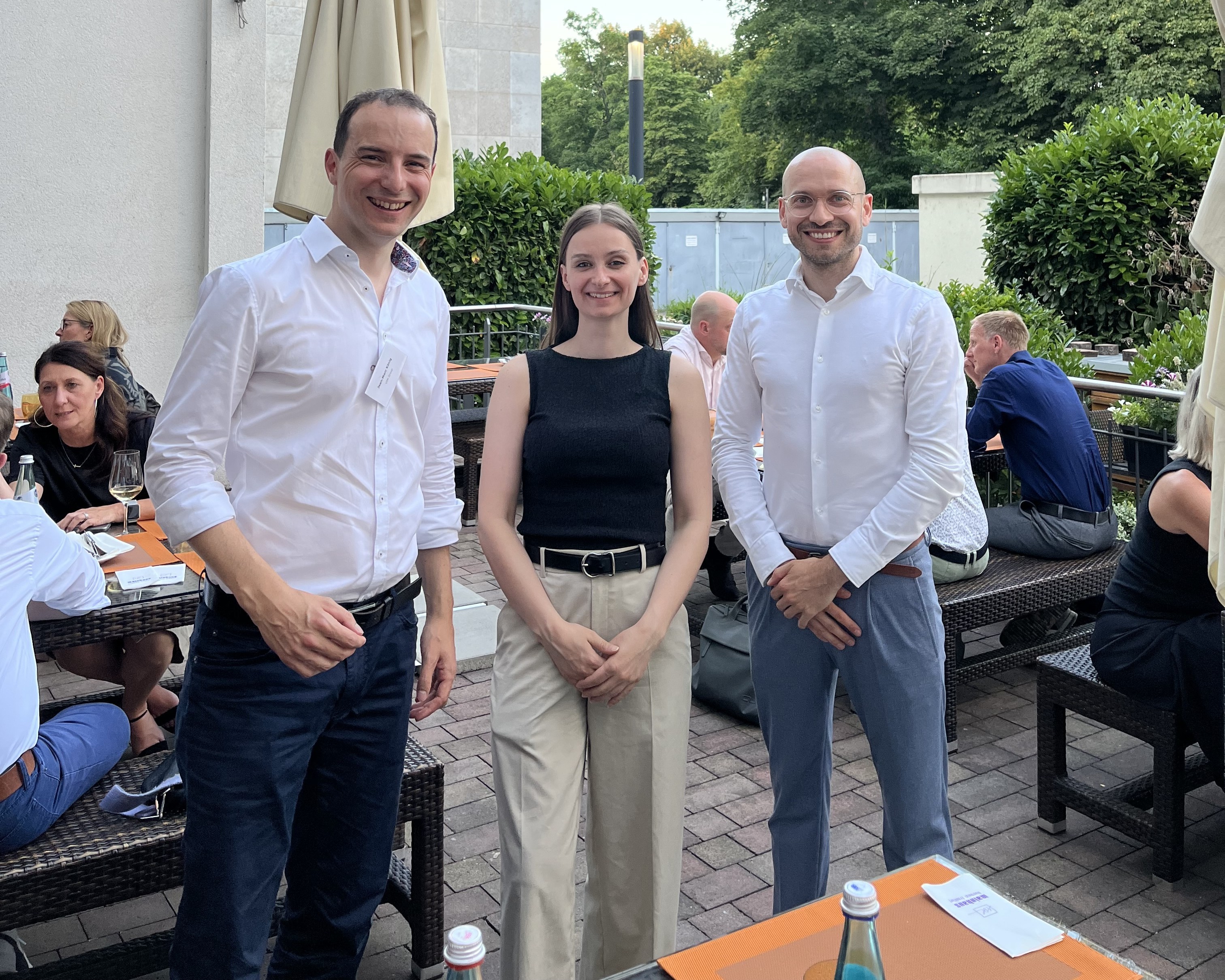
On the evening of July 1st, 2025, our exclusive “Markengeflüster” event took place in a summer-heated Frankfurt, where temperatures reached 37 °C. Thirteen brand leaders from companies such as Deutsche Bank, Engel & Völkers, Henkel, Schott, TÜV Nord, and TÜV Süd gathered for an inspiring and in-depth exchange on current challenges and strategic approaches in brand management.
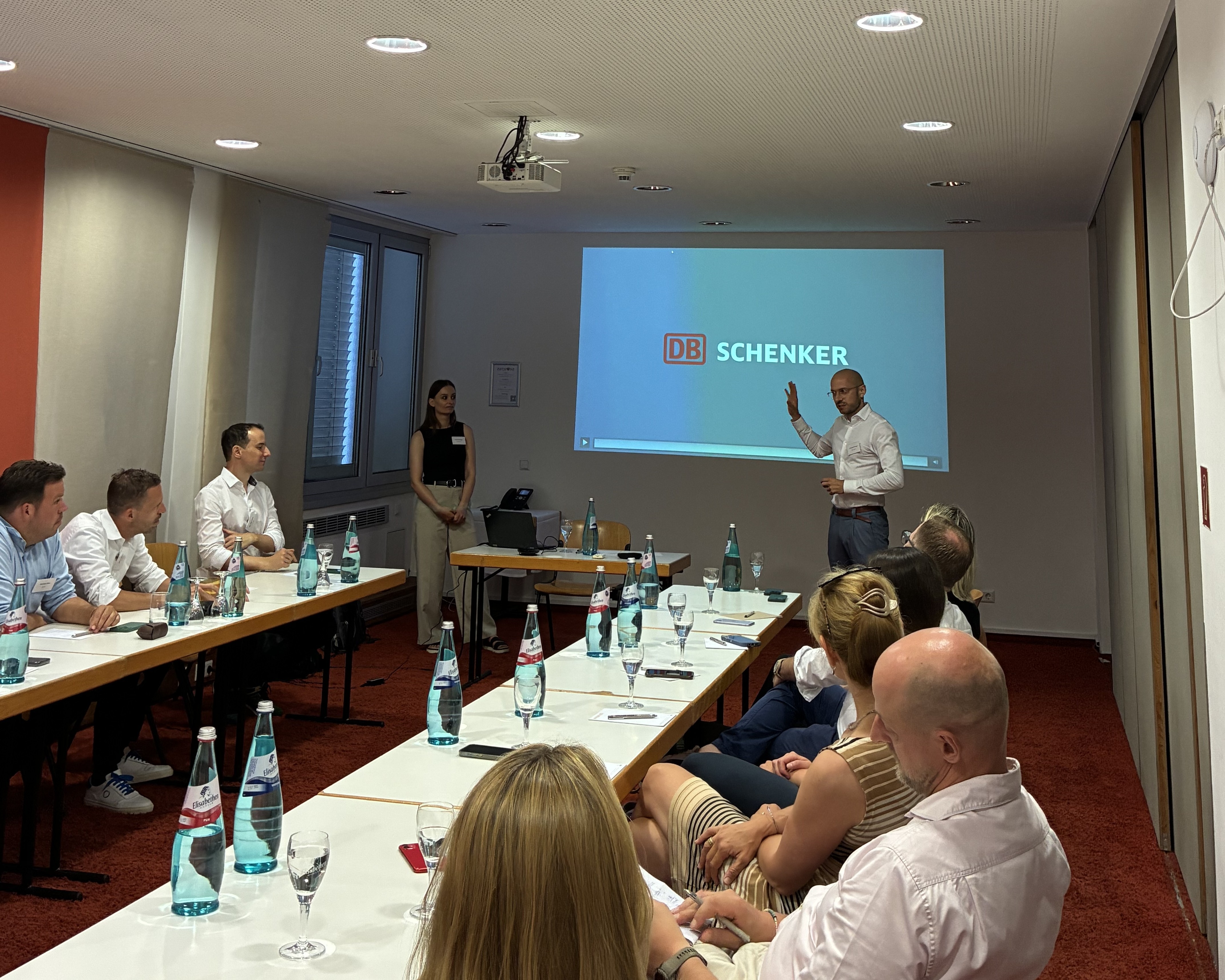
A highlight of the evening was the keynote by Maximilian Floegel and Aline Nünninghoff of DB Schenker, offering a behind-the-scenes look at their global marketing transformation. The inspiring exchange covered topics like digital collaboration, agile planning, and the role of AI in brand communication.
This article (in German) captures the key takeaways from DB Schenker’s marketing transformation, sparking lively discussions on structure, digital collaboration, and the future of brand communications.

Insight into the transformation at DB Schenker
The focus was on the keynote by Maximilian Floegel, Vice President Global Marketing & Transformation Communications, and Aline Nünninghoff, Lead External Content at DB Schenker. Under the title “Re-inventing DB Schenker’s Global Marketing & Communications Organization for a Technology Driven World”, the two gave an open and practical insight into the comprehensive realignment of the company’s global marketing and communications organisation.
Recognising and naming the challenges beneath the surface
The starting point of this transformation was the realisation that redundancy was a central problem. Products were occasionally promoted with several, sometimes contradictory marketing approaches.
The real challenges, however, lay deeper – beneath the surface. Three core problem areas were identified. First, there was structural ambiguity in the existing structures and processes. Second, the way of working was largely reactive, which showed in the corresponding mindset and operational behaviour. And finally, there was clear catching up to do in the area of digital fitness, both in terms of tools and of skills.
Three levers of the transformation
The presentation made clear how DB Schenker shaped the transformation along three central levers: structures and processes, way of working and mindset, and digital fitness.
“As part of the transformation we reduced the number of agencies from 27 to 6, among other things – that made us not only more efficient, it also raised quality considerably.” - Maximilian Floegel
Structures provide orientation
First, a shared understanding of the existing challenges was created, among other things through a worldwide survey of 120 employees, workshops in the “MarCom Evolution” series and several exchange formats such as the “Evolution Talks”. Building on that, clear structures and global centres of competence were introduced. A central wiki has served as a shared knowledge base ever since, complemented by the Brand Factory, which provides consistent marketing materials internally.
From reactive to forward-looking
To change the previously reactive way of working, a central planning hub was set up. It connects corporate objectives with the needs of business units and regions and, through forward-looking annual planning, provides strategic control. In addition, Mission Squads take on complex tasks, supported by structured capacity and sprint planning with Monday.com.
A digital platform as the backbone
A third focus was digital development. With Monday as a central platform and “one single point of truth”, information flows were streamlined, synergies encouraged and resource planning improved. Processes could thus be made more efficient, more transparent and more collaborative.
“Transparent planning acts as an efficiency engine and a motivation booster for the team.” - Maximilian Floegel
Learnings and discussions
The concrete learnings from the case were discussed particularly animatedly. Among the elements named as especially successful were the setting up of the planning hub, the continuous involvement of the teams, the interplay between the ticket system and the Mission Squads, and central control via Monday.com.
At the same time it became clear that certain areas can be developed further, such as longer-term capacity planning, better effort estimation for recurring tasks and closer integration of the Brand Factory into Monday.com.
Impulses beyond the case
Beyond the specific case, other topics also shaped the evening. The use of AI in brand communication was discussed intensively, particularly with regard to generating visual content and the question of how far AI actually contributes to greater efficiency. The use of tools such as Monday.com for structured collaboration also attracted a great deal of interest. In addition, there was in-depth discussion of internal communication, cross-departmental collaboration and the role of branding in complex organisations. Many guests were also particularly interested in exactly how DB Schenker shapes these change processes within the company.
“We are facing a similar challenge in our company, which makes this transformation all the more impressive – and I have taken a great deal away with me.” - participant at Markengeflüster
Conclusion: a successful evening with valuable insights
We thank all participants for the open and inspiring exchange. The DB Schenker case impressively showed how strategic brand management, digital tools and collaboration can interlock. The discussions during the evening and over dinner made clear once again how important personal dialogue among brand leaders is: to learn from one another, gain new perspectives and take away concrete impulses for your own work.
We are already looking forward to the next edition of Markengeflüster!